
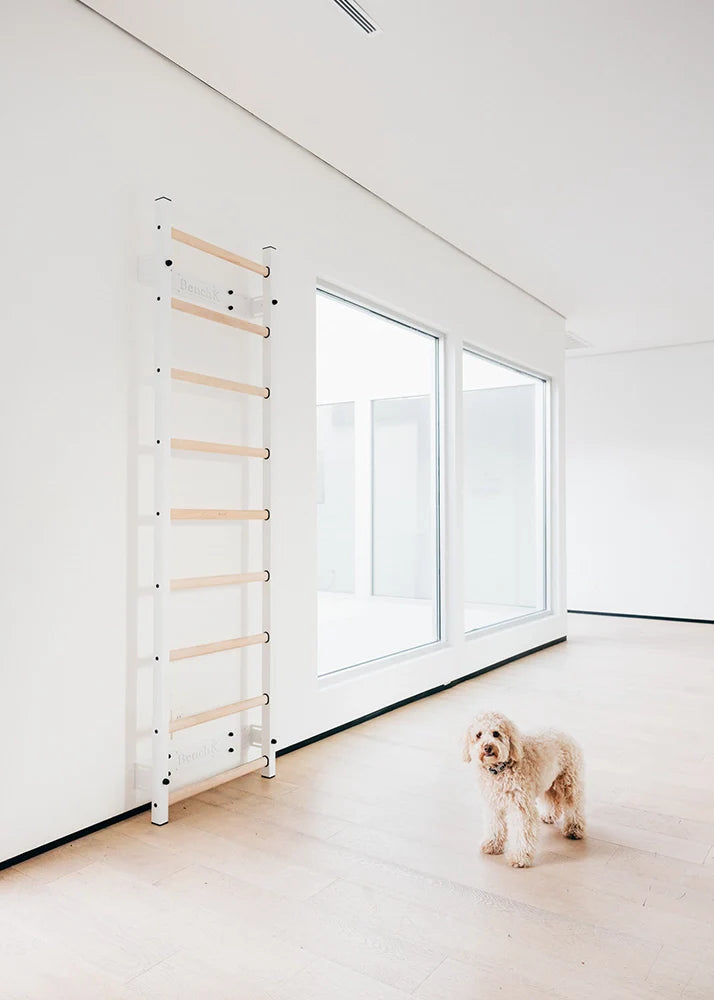
Gymnastic wall bars for home
When talking about the gymnastic wall bars, most of us will certainly see an image of a school gym, a professional fitness club or a specialized physiotherapy office. Meanwhile, it is a sports tool that is gaining greater adoption in daily use and becoming an essential piece of equipment for increasingly more houses and apartments. For those who have not had the opportunity to learn more about all the advantages of gymnastic wall bars, we have prepared a special mini-guide with the most important benefits of having gymnastic wall bars at home and tips on what to consider when choosing them.
Multifunctional sports equipment at your fingertips
The gymnastic Swedish ladder is a multifunctional piece of equipment that has great potential and creates a lot of opportunities, mainly related to everyday activity. We all realize the importance of movement, activity, regular training and proper exercise in our lives. Unfortunately though, we do not always have time or the opportunity to go to the gym, take a fitness class or spend time outdoors. With gymnastic wall bars at home, a chance to workout is always at your fingertips - at any time of the day or night. You can spend 10 minutes, half or two hours with it during the day, in the morning, afternoon or evening. You can exercise on the wall bars while keeping an eye on the children, cooking dinner or watching our favourite series. Wall bars come with a variety of additional accessories and add-ons, which allows you to personalize it so that it perfectly supports your favorite types of training, targeting all parts of the body in different ways and from different angles. Workout routine will never get boring. Thanks to this, you will be able to take care of your health, condition, fitness, figure and well-being, all without leaving your home.
Gymnastic wall bars - solution for every household member
BenchK multifunctional gymnastic wall bars is a piece of sports equipment suitable for people of all ages. It can be used by children - from an early age, adolescents, adults, seniors, pregnant women, people after injuries and struggling with certain health problems. The BenchK stall bars are not only used as exercise equipment - although of course, this is their primary purpose, they also create a perfect place to play, relax, rehabilitate, rest, work and even study. How is it possible? Thanks to many additional accessories, which, being fully compatible with the gymnastic wall bars, significantly increase the range of application possibilities.

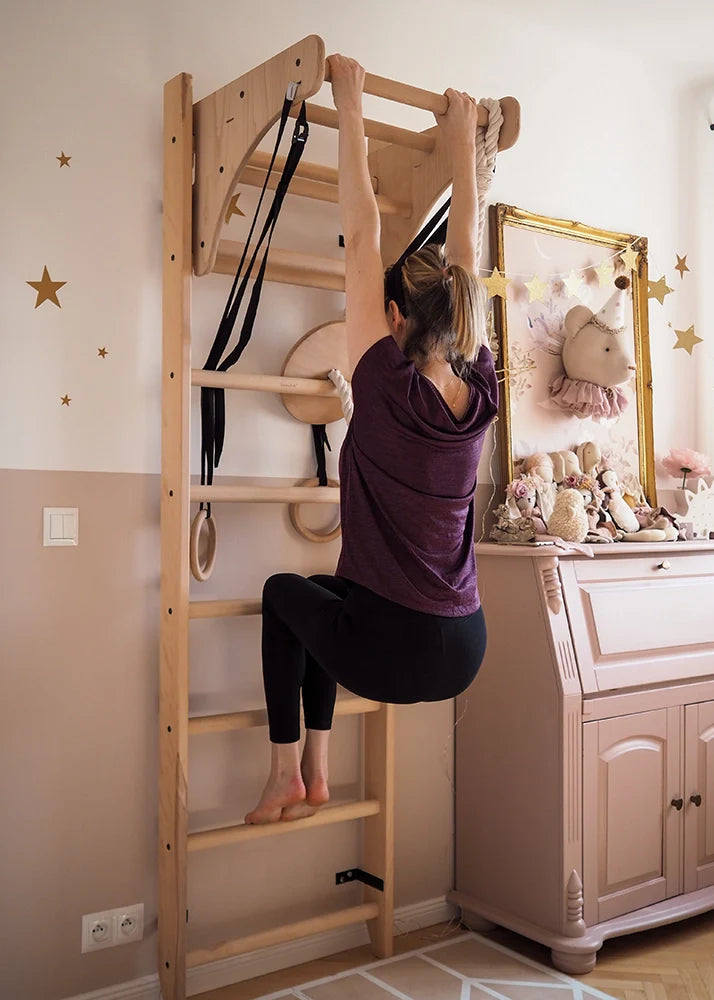
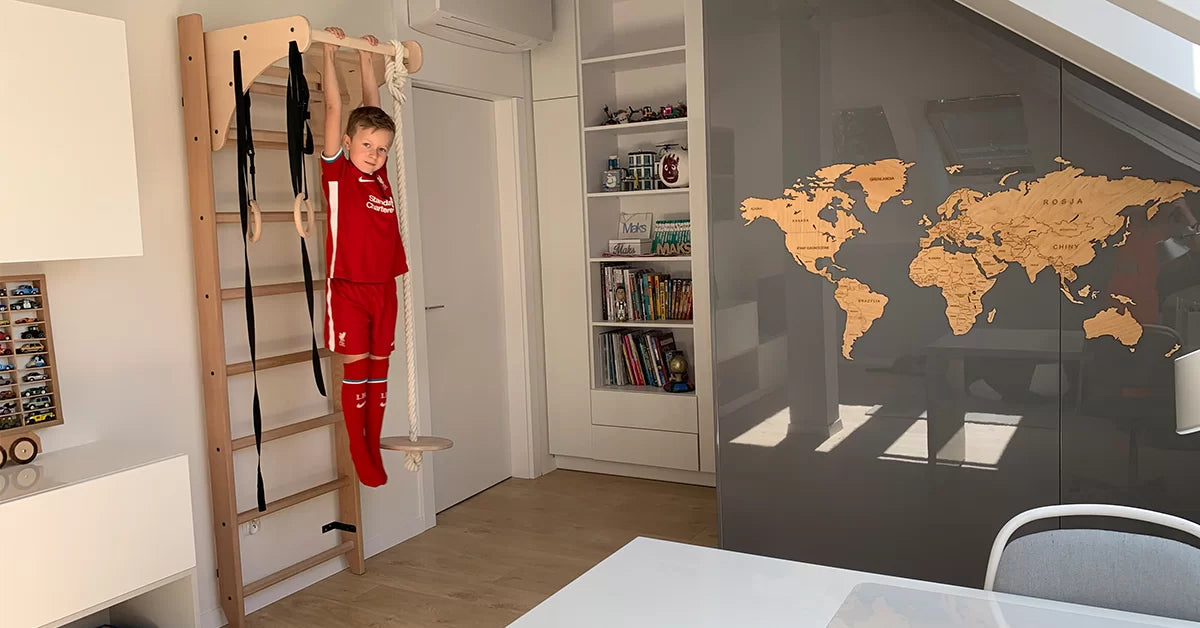
For example, BenchK gymnastic accessories include a pair of gymnastic rings and a climbing rope with a wooden swing. Such a set will surely appeal to the youngest lovers of thrills and fun. When it comes to children, safety is extremely important. It is worth noting that all BenchK wall bars meet the European safety standards for sports equipment PN-EN 12346: 2001 and PN-EN 913: 2019-03, so you can be sure that your child will not be hurt. In addition to exercise and play, BenchK gymnastic wall bars can also be used as a place to work or study - thanks to a special BenchTop used as a desk with adjustable wooden pull-up bar. It will work primarily in small rooms with limited arrangement possibilities, allowing you to work,study, or relax at the computer. On top of that, some accessories allow you to perform more advanced exercises and even professional training. These include a convertible steel 6-grip pull-up bar that can also be used as a barbell holder, the dip bar with back support, and a rotatable workout bench with additional seat and rollers for knee support.

BenchK wall bars - a sports piece of furniture in your home
Those who take care of every detail of the house or apartment arrangement do not have to worry about the fact that the gymnastic wall bars could spoil the results achieved so far. First of all, it takes up little space, so it will fit into any room, no matter how small - be it a child's room, office, hallway or living room. Secondly, BenchK multifunctional wall bars are made with innovative and trendy design, crafted with attention to every detail, thanks to which they will easily fit into the arrangement of any, even exclusive room, giving it a unique character. A wide range of models will allow you to choose the equipment that will be closest to your liking.
Multifunctional gymnastic wall bars at home bring a lot of benefits for the whole family. Once you have this sports furniture, you will quickly notice its positive impact on your health, physical condition, well-being and family relationships, which can be deepened thanks to joint activities.
Rehabilitation wall bars at home for a child and an adult
The modern lifestyle, in which the lack of sufficient physical activity, the predominance of sedentary work, and excessive physical and mental strain - all these factors make us feel pain, especially in the lumbar and spine areas. This problem affects not only adults but more and more often also children, contributing to posture defects and causing significant discomfort. Rehabilitation helps to reduce pain and has a relaxing effect on the body and mind.
The vast majority of people associate rehabilitation only with professional procedures performed in rehabilitation offices or other medical facilities. However, Rehabilitation exercises are also used in the case of minor injuries, soreness or discomfort ailments and nothing prevents you from doing them at home. All you need is the right equipment.
Rehabilitation wall bars at home
Who doesn’t remember gymnastic wall bars from the school sports hall? Nowadays more and more often, wooden or metal gymnastic ladders become an essential part of our houses or apartments . Getting your own gymnastic wall bars has a lot of advantages. BenchK as a manufacturer of gymnastic wall bars creates multifunctional products with a wide range of applications. BenchK gymnastic wall bars with accessories are used both for gymnastic and corrective exercises, as well as for home rehabilitation. They allow you to perform a wide range of full body exercises, strengthening and regenerating the spine. In addition, they are a great tool that activates and brings together the whole family while having fun and physical activity. BenchK wall bars have been designed in such a way that they can be easily installed in even a small room, and their designer appearance also makes them a modern element of the apartment's decor.
Rehabilitation wall bars - for whom?
Excessive strain on the spine affects all of us. - Children, accumulate it by carrying way too heavy backpacks, spending many hours in a sitting position, or acquiring injuries; adults - doing too little physical activity, or gaining excessive body weight. In such cases, home exercises using the BenchK rehabilitation wall bars will be the best solution for everyone, regardless of age. In addition, for the elderly and people with injuries, fractures, or limited mobility, an invaluable help will be installing rehabilitation wall bars next to the bed. In such way it will be much easier for them to rise to a sitting position and perform simple exercises.

BenchK wall bars at home - is it worth it?
We are aware of the importance of physical activity in our lives. It has a positive effect on our health, appearance, and general well-being. When we do not have the opportunity to go to the gym or fitness classes, when there are no physical activities for children available in the area, or simply when the weather conditions are not conducive to outdoor sports, then the gymnastic wall bars at home is the best possible solution. BenchK offers a wide range of models, from which everyone can choose the right one for themselves and their family - a wooden or metal gymnastic wall bars, with a pull-up bar, a workout bench, and dip bars, or with gymnastic accessories. All products are made of the highest quality materials, thanks to which they have durable construction and are extremely durable. BenchK gymnastic ladders meet all safety standards and ensure the comfort of use, thanks to their optimal size and comfortable rungs. Among the many advantages of the gymnastic wall bars at home, it is also worth mentioning that we always have it at our fingertips. We can use it at any convenient time, without having to leave the house. This allows you to save a lot of time, and this is a very important aspect of modern life. In addition, we can exercise while watching our favorite series, listening to music, or during a break between cooking or during a toddler's nap.
On top of that, gymnastic wall bars will be a great addition in a child's room, where they will be both a tool for exercise and fun. BenchK offers additional accessories for children, such as a climbing rope with a wooden swing, gymnastic rings, a desk in the form of an overlay for a ladder or mattresses, thanks to which you will not have to persuade your child to rehabilitation and activity for a long time, even through play.

Gymnastic wall bars enable fruitful spending time with the family. Joint rehabilitation exercises, adapted to the abilities of adults and children, bring benefits and lots of fun to being together. In addition, parents become role models for their children in the field of physical activity, which is certainly true and will have a positive impact on their future.
Rehabilitation wall bars at home is therefore the best solution for the whole family, enabling daily exercise to improve the condition, and physical fitness and eliminate pain or strengthen the spine. Thanks to such multifunctional sports equipment, rehabilitation does not have to be boring, and most importantly, it is the best investment in your own health.
Exercise at home on a gymnastic wall bars - an idea for training
Is your life such that you do not have time for regular gym exercises, you cannot spare yourself time to join a fitness club, but you cannot imagine your life without training? Then the best solution is a multifunctional device that will be perfect at home and can replace the entire gym.
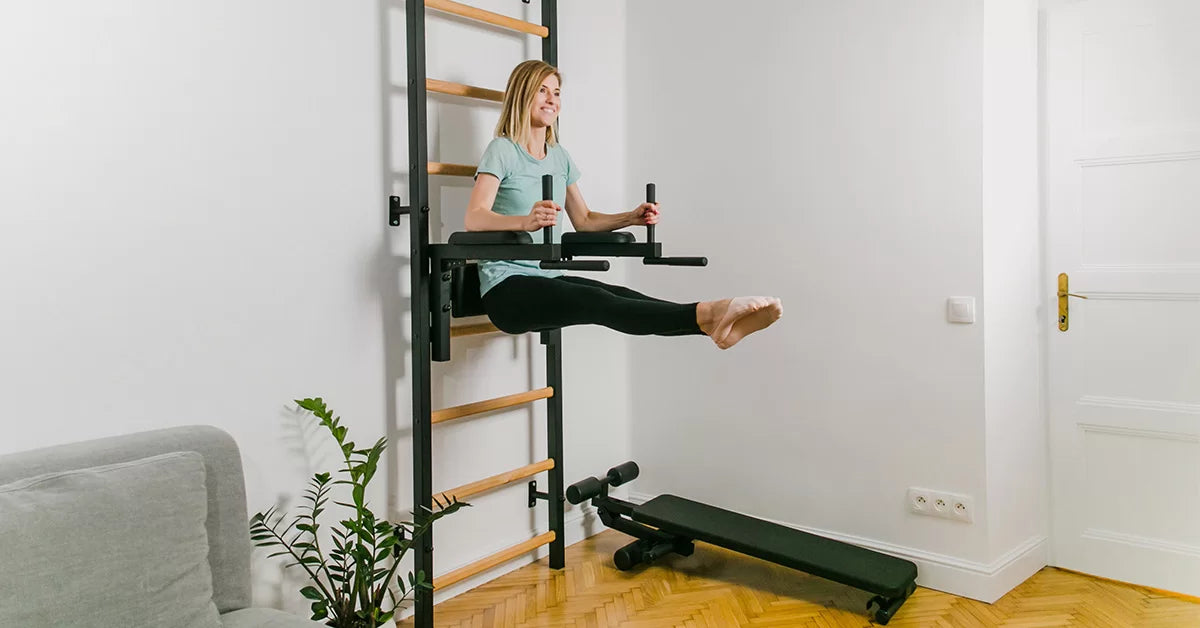
The equipment includes a gymnastic wall bars, a dip bar with armrests and backrests, a pull-up bar with handles, and a training bench. This versatile "gym" allows you to perform a variety of exercises for all muscle groups. It is enough, for example, to change the position of the bar, and it will serve as a chuck or barbell holder. The bench is double-sided, which means that it is suitable for both abdominal training and dumbbell exercises. What else can we do with the BenchK multifunctional wall bars? We advise you some.
Exercises that can be performed on a gymnastic wall bars - home training
First of all, remember that warming up before exercise is the most important introductory part when practicing your workouts. A proper warm-up will reduce the likelihood of injury. If you want your exercise to bring better results - do not forget about a proper warm-up. You may think that training on a gymnastic wall bars can be boring. After all, most people associate such equipment with the school gym, where the wall bars were not used to their full potential. However, thanks to multifunctional wall bars, you can perform a number of exercises that will strengthen your body, improve condition and shape the figure. A multifunctional wall bars with accessories is the perfect equipment for various workouts and combinations of exercises that stimulate all the muscles of our body. For training, you can additionally use TRX resistance trainers for exercise with your own body weight, resistance bands or a mat.
Exercises to strengthen the abdominal muscles
RAISING THE LEGS IN THE SUPPORT
Stand with your back to the ladder, place your forearms on the armrests and grasp the handles with your hands. The feet should touch the ground. From this position, lift your legs up as close as possible to your chest or chin, while bending them at the knees. Keep your legs elevated for a moment, then lower them to the starting position.
RAISING THE LEGS IN THE SUPPORT WITH TORSION MOVEMENT
During this exercise, you should follow the same procedure as described above, with the difference that when you lift your legs up with bent knees, you need to twist your lower body - that is, direct your knees first to the left and then to the right, trying to touch the rungs, at the same time keeping the spine from the wall bars.
RAISING THE LEGS AND TURNING IN A HANGING POSITION
Grab the top bar shoulder-width apart and straighten your arms. In this version of the exercise, the legs should hang freely downwards. Being in this position, lift your legs up as close as possible to your chest or chin, while bending them at the knees. We keep our legs elevated for a moment, then lower them to the starting position.
SIT UPS ON THE BENCH
You have to get comfortable on the bench, lock your legs on the rung and put your hands behind your head. Then lift the torso up so that the forehead is as close to the knees as possible, distributing the weight of the body between the abdominal muscles and the back muscles.
KNEE JUMPS WITH A SUSPENSION TRAINER
First, attach the straps properly. We start from the starting position, supporting the arms straightened in the elbows, as for push-ups, with the feet placed in the handles of the straps. Then we make the movement by lifting the hips, while bending the knees, directing them to the chest. At the moment of maximum tense, hold the position for a few seconds and then slowly return to the starting position.
LATERAL HIP RAISING SUPPORTED ON THE ELBOW
We start by lying on the side and supporting the body on the elbow and forearm. Straighten the legs at the knees and connect them, resting them on the second rung from the bottom of the ladder. Then we lift the hips up so that the torso is in line with the legs. We tense the muscles of the abdomen and buttocks, holding this position for a while. We repeat the exercise several times on one side, then lie down on the other side to do it on the other side.
Upper body exercises
DIPS ON THE DIP BAR
It is an exercise involving the upper body strength. To do it, stand in front of the wall bars at a short distance from it, rest your hands on the handles of the dip bar so that the entire weight of your body rests on your hands. One foot is placed steadily on the ground, and the other is placed on it, then we perform the dips, bending our arms at the elbows and bringing the torso closer to the ladders, then straightening and returning to the starting position.
PUMPS AT THE LADDER
An exercise similar to the description above with the difference that without the use of the handrail. We grab the rungs of the ladder with our hands so that the entire weight of the body rests on them, rest both feet firmly on the ground, and then perform push-ups as described above.
INVERTED ROW
For this exercise you will need Resistancestraps attached to the ladder. Stand at a certain distance from the ladder so that the tape is taut. We grab the tape with our hands so that we feel stable. Then, remembering about keeping the spine straight, lower the body down, leave the feet in the same position, and transfer the entire body weight only to the hands and shoulders, and then lift them up, taking the starting position.
BICEPS WITH TRX TRAINER
It is a version of the exercise similar to the one described above, with the difference that we try to keep the body in the same position, using only the strength of the biceps muscle.
TRICEPS WITH THE TRX TRAINER
As in the exercise above, this time we use the strength of the triceps muscle of the shoulder, but we stand with our back to the ladder, grasping the straps with our hands and alternately lowering and lifting the body with the strength of the muscles.
Single-handed rowing paddle with a resistance band
To perform this exercise, kneel with your left leg on the bench, leaning your left hand on the bench, place your other leg firmly on the ground, and grab the resistance band with your right hand. Then, with the strength of the muscles of the hands, we stretch the tape, making a fall, bending the arm resting on the bench in the elbow. After the fall, we return to the starting position. We repeat the exercise several times and then change the side.
Exercises for the muscles of the legs and buttocks
BULGARIAN SQUATS
With your back to the ladder, rest the selected leg on the second rung from the bottom. Place the other one firmly on the ground (it should be slightly forward, as in the case of lunges). The weight of the body should be transferred to the front leg by squatting, going as low as possible. Hold for a while and then return to the starting position.
HIP PUSHING DOWN WITH LEGS CLUTCHED ON A LADDER
Lie down on the mat next to the ladder, place your feet at the height of the second rung from the bottom, and place your hands freely along your body. Then we try to push the hips up as high as possible, leaving the shoulder blades "stuck" to the ground.
HIGH SQUIRT WITH THE HELP OF EXERCISE BELTS
We stand in front of the ladder, grasping the straps attached at the height of the chest, our arms are slightly bent. We keep the back and lumbar section straight, tighten the abdominal muscles and buttocks. Then we squat to a position below the right angle, keeping the straps slightly taut, followed by dynamic extension of the knees along with the jump. When descending, the jump should be cushioned by bending the knees, and by directly descending to the squat position, we prepare for the next jump.
SITTING ON ONE FOOT WITH EXERCISE BELTS
We stand in front of the ladder, grasping the straps with both hands so that they are tight. Then we do squats on one leg, trying to maintain balance and working with the muscles of the hands.
STAND ON THE HEAD BY THE LADDER
When doing this exercise, remember to use a mat or gymnastic mattress. You should stand in front of the ladder and place your hands on the ground in front of them at a distance of 20-30 cm. Place the arms at shoulder width, parallel to each other, and straighten the elbows. Then we dynamically bounce off the ground, lifting our hips up and swinging our legs in a scissor movement until the straightened legs rest on the ladder. Hold the weight of the body for a few seconds on the hands and then return to the starting position.
LEG STRETCHING AT LADDER
This exercise can be performed in several variants. In one of them, we stand in front of the ladder at a slight distance from it, keep one leg steadily on the ground, and rest the other leg, straight at the knee, on the ladder rung at such a height as to create a right angle. Then we bend the torso to grasp the rungs with our hands and touch the knee with our forehead. Another option is to perform the same steps while standing sideways to the ladder.
Below you will find descriptions of many other exercises that can be performed using a gymnastic wall bars with accessories.
Dumbbell extrusion on a flat bench
Lie down on a flat bench. Lift the dumbbells up - the arms should be shoulder-width apart and the wrists with the thumbs pointing towards each other - then lower them down.
flyers WITH BARBELLS, LAYING ON THE SLOPE BENCH
The bench should be set at an angle of 30-45 degrees. Begin the exercise with your arms straightened (fingers pointing towards each other), and while moving, slightly bend them at the elbows.
SITTING BARBOOK LIFTING
In the starting position, the torso is slightly tilted, arms with dumbbells are slightly bent at the elbows, lowered with both sides facing in. Lifting movement with bent arms, elbows in advance of the hands in every phase of movement. The dumbbells should be raised above the shoulder line and slowly lowered without stopping.
arnold press IN THE SEATED POSITION
Grasp dumbbells and raise them to shoulder height so that the fingers of the hand are facing the body, then at an even pace you need to push the dumbbells over the head to a position where the arms are not yet locked - when squeezing the dumbbells, turn your hands so that in the final phase of the movement, the fingers were pointing forward.
RAISING THE LEGS IN THE SUPPORT
You have to stand with your back to the special support, rest your arms on the horizontal crossbars of the support, grasp the handles with your hands - at this point the body is above the floor. From this position, the legs should be lifted up towards the chest, keeping them straight in the advanced version or bending them at the knees in the basic version.
RAISING THE LEGS ON THE BAR
Grasp the straight bar with a grip or a grip. Raise your legs as high as possible to your chin. You can also introduce torso twists in the final phase of leg lifting in this exercise.
THE TORSION OF THE TORSO IN THE HANGER
You have to hang freely on the bar, then pull up your legs and slowly twist your torso, stop for a moment at the very end. Without changing the position of the legs, turn to the other side.
PUMPS ON RAILS
Grasp the handrails with a hammer grip with your legs bent 90 degrees from your thighs, then lower your body by bending your elbows.
LOWERING ON A STICK
You have to stand on the platform so that the chest is closest to the bar. Then bend your legs and, keeping on the bent arms, slowly lower the position.
PULLS NEGATIVE
You have to get above the bar from the ground and very slowly, keeping your body taut, lower yourself down until the elbows are completely straight.
WIDE GRIPPING ON BAR
Grasp the bar wider than shoulder width and pull up so that your chin is above the bar. Then the body is slowly lowered.
TORSIONS OF TORSO IN LAYING
We lie down on an oblique or horizontal bench, the back and hips touch the ground, hands are clasped at the neck or on the chest. From this position, we slightly lift the shoulders and head, tearing the back off the ground, and at the same time twisting the torso from one side to the other.
RAISING THE LEGS ON AN SLOPING BENCH
You have to lie down on a horizontal or oblique bench with your head up, your arms behind your head, your torso pressed against the ground. From this position, we lift the legs to the chest, while slightly bending them at the knees.
It is true that exercising with a multifunctional wall bars brings positive benefits. However, we must remember about properly performed trainings. Correct technique and focus during exercise, as well as proven training equipment are important here.
Top 10 morning exercises for you at home
You get up in the morning and would like to start your day well. Certainly, there will be a group of people who think that strong coffee will do the trick and get you back on your feet even after insufficient sleep. There are also those who cannot imagine a morning without visiting the gym. However, when you notice that the coffee is not enough and only helps for a moment, and you have neither the time nor the opportunity to go to the gym, you can also successfully do morning exercises at home. They bring many benefits and will quickly become a routine you can’t do without. Here are the top 10 morning exercises to start your day with.
Morning training - why is it worth it?
We do not even realize how much morning exercise can positively affect our bodies and well-being. First, they let us wake up and give us the energy we need throughout the day. They activate both body and mind - the body becomes properly enriched with oxygen, the muscles and joints are warmed up, and the entire body is stretched. Thanks to morning exercises, we will feel lively, fresh, and light. Our concentration will also improve and we will be more susceptible to learning new information.

Morning training also strengthens the circulatory system and stimulates the metabolism, thanks to which you can get rid of unnecessary weight faster. First, more blood is pumped as you move, allowing it to circulate faster around your body and preventing cholesterol from building up in your arteries. Secondly, it speeds up the metabolism, allowing you to burn calories consumed throughout the day faster. Starting the day actively will significantly improve our mood. All thanks to endorphins, the happiness hormone that is released during exercise. No doubt, a good mood and a smile are the basis of a well-lived day.

Exercising at home - how to prepare?
Morning training does not require any special preparation. You don't even need a sports outfit - comfortable pyjamas will do just fine. It’s best to do the exercises right after waking up, before breakfast. When it comes to warming up, the exercises themselves are doing just that, because in the morning we should not do very intense exercises, but rather those that will stretch and activate our body. For training at home, the BenchK multifunctional gymnastic wall bars will be perfect, as they allow for many varieties of exercises, easily adapting them to the individual capabilities of each person and ensuring safety.
Below, we present a set of the top 10 morning exercises performed at home with the use of a BenchK gymnastic wall bars.
1. Pendulum
Stand in front of the wall bars and grab the rung with both hands at the level of the chest. Straighten the spine, and then, during a gentle jump, move the feet and body weight from side to side.
2. Squats
Stand in front of the wall bars and grab the rung with both hands at the level of the chest. Perform traditional squats until the elbows are completely straight.
3. Jumps
Stand in front of the wall bars and grab the rung with both hands at the level of the chest. Switch legs in the air by placing one foot and then the other on the lowest rung of the wall bars. To make the exercise a bit more difficult, you can put your feet on the second or third rung from the bottom or increase the pace.
4. Half-crunches
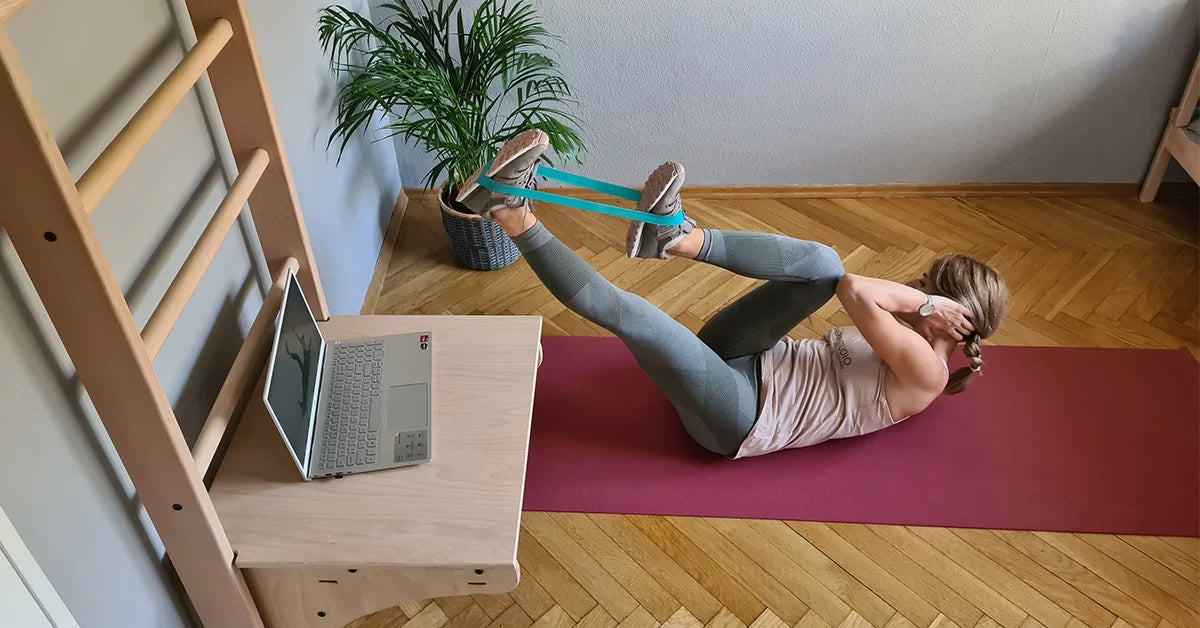
Lie down on your back so that you can hook your feet on the lowest rung of the gymnastic ladder and at the same time gently bend your knees. Bring your hands behind the head, and then perform crunches, only slightly lifting the torso, without touching the knees with the head.
5. Side turn
Stand with your back to the wall bar and feet slightly apart. Twist the torso to the right, then to the left, trying with the hands to touch the rung at the level of the chest. Remember not to lift the feet off the ground and keep the spine straight at all times during this exercise.
6. Climbing the wall bars
Stand in front of the wall bars and then climb the individual rungs, remembering about the appropriate work of arms and legs - when the right hand grabs the next rung, the right leg also rises with it, as does the left arm and leg. Once you reach the highest rung, go down in the same way. Repeat several times with a steady pace.
7. Hanging
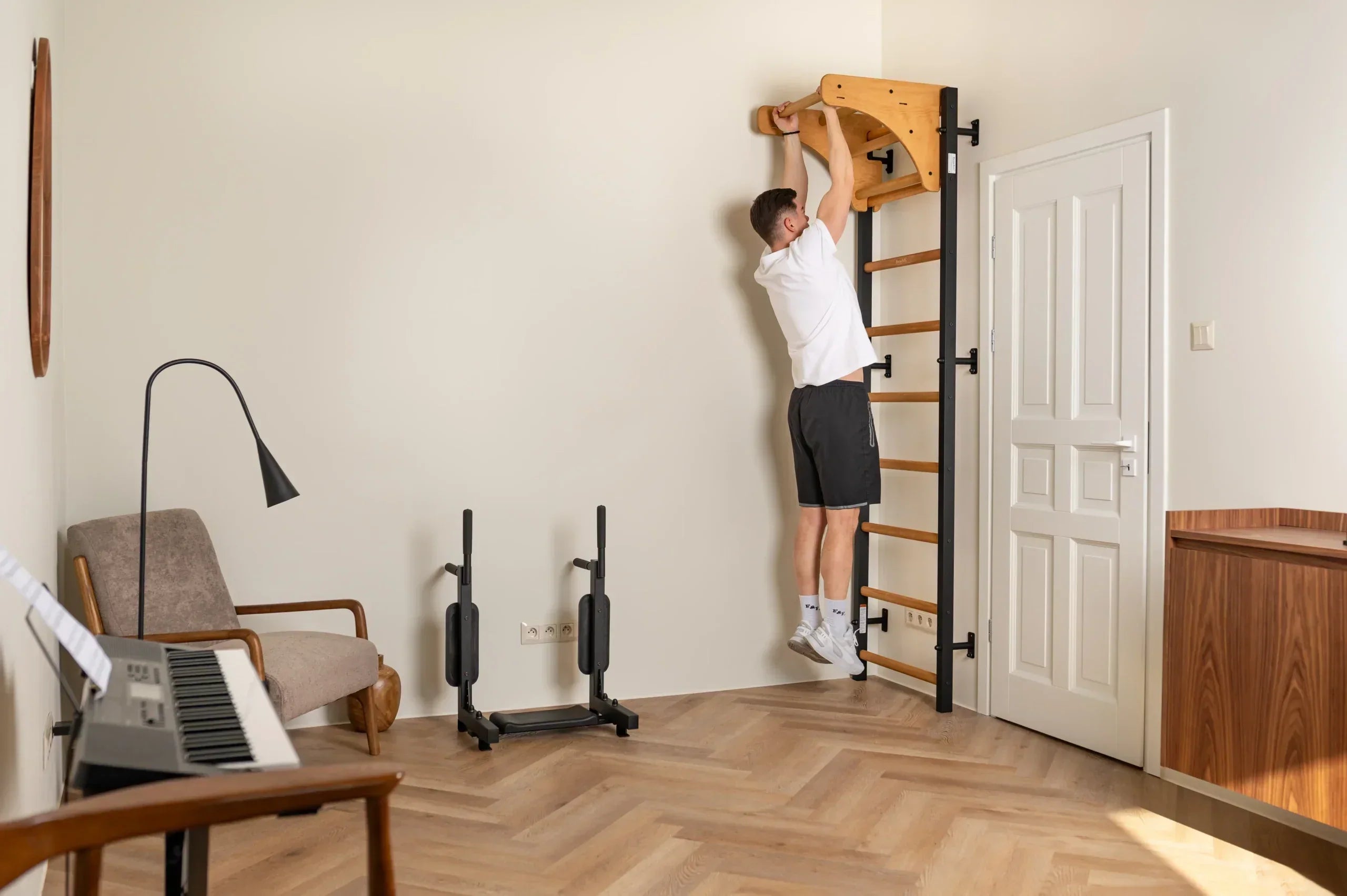
Stand with your back to the wall bars, stretch your elbows out as high as possible and grab the rung that will allow you to hang freely from the wall bars, without your feet touching the ground. Straighten the spine as much as possible and remain in this position for some time.
8. Reverse squats
Stand with your back to the wall bars, stretch your elbows out as high as possible and grab the rung that will allow you to hang freely from the wall bars, without your feet touching the ground. Then bend your legs at the knees and raise them as close to the chest as possible, keeping in mind the straight spine adjacent to the wall bars.
9. Swing your legs backward
Stand in front of the ladder and grab the rung with both hands at chest level. Then lift the leg back to the maximum possible height.
10. Raising the hips
Lie on your back so that your feet are resting on the second rung from the bottom, and hands are placed along the sides of the body. Try to push the hips as high as possible, remembering that the shoulder blades stay on the ground all the time. Keep the hips elevated for a few seconds and then return to the starting position.

Gymnastics at home - what exercises are worth doing?
Corrective gymnastics is a great way to eliminate posture defects. It is particularly useful for children and young people, but can also be beneficial for adults. You do not need to sign up for a special gymnastics class to start exercising. Many of the exercises can be successfully performed at home - even without professional equipment. If you or your child are already attending corrective classes, home gymnastics will be a perfect complement to these classes.
Exercises to do at home by yourself Gymnastic exercises can be performed in order to prevent posture defects and to correct existing issues. You don't need a lot of different specialized equipment to start doing them. All you need is a gymnastic wall bar and a suitable mattress - you will find them in our offer. What exercises can you do with them?
Legs and torso lifting. For convenience and safety, this exercise can be performed on a gymnastic mattress. Lie on your stomach and place your hands on the sides of your head. While remaining in this position, raise your torso, arms, and legs at the same time, hold for a few seconds, and then lower them. The number of repetitions should depend on your capabilities, but five to ten repetitions are recommended. Pulling the shoulder blades while sitting Sit on a chair with your back straight. Then, clasp your hands at the back of your head and slowly pull your shoulder blades together while tilting your elbows back. Try to stretch as much as possible - as far as possible, of course. A gentle feeling of pain should be the limit here. Finally, come back to the starting position. Eight to ten repetitions of this exercise are recommended. Kneeling arms stretching For this exercise, which is useful in strengthening and opening your arms, you will need a gymnastic wall bar. Kneel down and grasp the rung with your hands at such height that you can keep your arms in line with your body. Stay in this position as long as possible, but watch out for any pain that may arise. Rear half-overhang on the wallbars Stand with your back to the ladder, put your arms up and grab the appropriate step. Then bend your knees a little and try to stay in this position for as long as possible. This exercise is recommended especially for the correction or prevention of scoliosis among children. It stretches the spine and also strengthens the arm muscles, elbows and wrists.

Push-ups at the wallbars Place your feet on the bottom step of the ladder and grasp the rung at chest height with your hands. Hold the ladder on outstretched hands, then bend your arms at the muscular joints. You can repeat the exercise any number of times, but remember to keep your spine straight. Forward bend Stand with your back to the wall bar, stretch your arms up and grasp the rung with your hands. Then bend your torso forward while stretching your abdominal muscles. Try to exhale as you bend forward. Adjust the number of repetitions to your own abilities, paying attention to pain in the lower back.
As you can see, it doesn't take much to maintain your health and correct posture with corrective gymnastics. You can exercise at home without any equipment, but it is worth getting a gymnastic wall bar and a gymnastic mattress.
Children and Sport. When can You enroll your child to sports?
The natural desire of every parent is to raise strong and healthy child. It is clear that sport can help your child to be healthy. But it is not often we can get a definite answer to such questions as, what is the best age for child and when he can participate in sports activities. Of course, you need to approach each case individually. In this matter a child's gender is very important, also the level of child's development, and finally, whether he has a predisposition to do any of sports activities.
You should also take into account the feelings of the child. A child should be willing to do exercises, otherwise it will affect negatively on his mental condition. If parents do not take into account the views of a child they should expect a rapid loss of the interest of their child to do any sports. It is likely that after the first negative experience with sports, the child completely loses the willingness to engage. To avoid such cases, parents should seriously think about the time when to enroll their child to extracurricular activities.

Assessment of physical development of a child
The first important step it is a consultation with a doctor. You shouldn’t neglect this advice, because at stake there is a health of a child, and even his life. The doctor will examine the child and he will find if there are any of contraindications and also he will assess the level of the child’s physical development. Next, try to talk with the parents whose children are already enrolled in some sports classes. Find out at what age their children began to attend sports training, and whether there are any additional problems.
Choosing of the type of sport activity in accordance with the age of a child
As it was mentioned above, the choice of the extra-curricular activities should take into account the child's age. However, every year appear new progressive exercise programs; therefore, the rules of the sport are rejuvenated. Good examples of these programs are such sport’s activities as modern rhythmic gymnastics, figure skating, synchronized swimming and others. Even three-year-olds children can start practicing in these sports activities, because the younger the child is the more he can work out. There are even some cases when the professional trainers personally come to the kindergarten to identify talented children. When the girl reaches the age of four years she can begin to attend classes of artistic or rhythmic gymnastics. And in this age girls also can start learn how to swim. At the same time, if after the first year of training the girl will probably floating in water, it is possible that she will be qualified to synchronized swimming. Girls of eight or ten years old can already take part in the worldwide championships in this field. At the age of six if the child does not have any counter indications, so you can go ahead and enroll your child to class of the figure skating. Seven-years-old children can start to do such sport activities as artistic gymnastics, sport dance and table tennis.

The boys of eight or nine years old can start to learn Martial Arts. Very carefully you should approach your child to weightlifting sport. Although formally the child can start this sport at the age of 10, but it will be better to do it a little bit later. The body of the child is not yet fully developed at this age, and such exercises in the gym can significantly slow his growth. Let us examine more details of some kinds of sports. The classes of Martial Arts are very well developing the flexibility, coordination, dexterity and disciplinein children, and they are recommended both for boys and for girls. Some types of fights definitely are not suitable for young athletes. For example boxing, which is very conducive to injuries and it is a common cause of the epilepsy. Much more securable are karate, judo, aikido or wushu - basically a five-years-old child can participate in these activities. Gymnastics both artistic and rhythmic are very demanding kinds of sport. Heavy loads often lead to sprains, cause back pain.
Of course, while doing such sport they can develop their flexibility, grace and beauty but is it worth of such efforts? If it is hard for your children, you can enroll them to dance classes or ballet, where are all these same features, but at a lesser intensity. To achieve mastery in this sports section, your child should start practicing since the age of five. Children that begin to cultivate ballet or dance later also are not convicted to fail. Perhaps no other sport can be so safe and at the same time so useful for all ages as swimming. It helps to develop the right stature and improves body condition. You can start the swimming classes with your child at least of the age of three months, because there are a lot of pools, conducting special courses for babies. The only thing that can bring some concerns to parents of girls is the possibility of the emergence of broad shoulders. However this can happen only with the professional swimmers, but for those who want to swim twice a week, it will not cause such changes.

It doesn’t matter if it is a room for a boy, a girl or both siblings you should think about the organizing of a space for active entertainments. The solution can be the Metal Gymnastics Wall bar in the child’s room.